

6G Integrated Sensing and Communications (ISAC)

Introduction
The sixth generation (6G) of wireless communications is expected to fundamentally transform mobile networks from pure communication platforms into intelligent sensing and communication infrastructures. One of the most revolutionary technologies enabling this transformation is Integrated Sensing and Communications (ISAC).
ISAC combines wireless communication and environmental sensing within a unified network infrastructure, allowing the same radio signals, spectrum, antennas, and hardware resources to simultaneously support data transmission and sensing functionalities. Unlike traditional networks where communication and sensing systems operate independently, ISAC enables cellular networks to act as large-scale distributed radar systems capable of detecting, locating, tracking, imaging, and understanding objects and environments while maintaining high-speed communications.
A 6G ISAC tower sends out a single wireless signal that does two jobs at once — it talks to your devices (solid blue waves) AND bounces back from objects to "see" what's around it (dashed amber waves), just like a bat using echolocation while also singing.

This is expected to become one of the defining pillars of 6G, enabling applications such as autonomous transportation, smart factories, digital twins, healthcare monitoring, drone traffic management, industrial robotics, immersive XR experiences, environmental monitoring, and military operations.
According to research initiatives from the International Telecommunication Union (ITU), 3GPP, Next G Alliance, Hexa-X, and major industry players, ISAC is expected to become a native capability of future 6G networks.
Historically, communication and sensing systems evolved independently.
Communication systems focused on:
Delivering information between users
Maximizing throughput
Reducing latency
Improving reliability
Sensing systems focused on:
Object detection
Distance measurement
Velocity estimation
Environmental awareness
Examples include:
Radar systems
LiDAR
Sonar
Cameras
Traditionally these systems required:
Dedicated hardware
Dedicated spectrum
Separate infrastructure
This separation leads to:
Spectrum inefficiency
Higher deployment cost
Increased power consumption
Infrastructure duplication
The growing scarcity of spectrum resources and increasing demand for environmental awareness motivated researchers to merge these functionalities.
ISAC emerged as the solution.
Instead of using separate systems, a single 6G radio network performs:
Communication
Positioning
Localization
Object detection
Motion tracking
Environment mapping
using the same waveform and infrastructure.
2. Why ISAC is Important for 6G
6G networks aim to provide:
Tbps data rates
Sub-millisecond latency
AI-native operation
Native sensing capability
Digital twin support
Extreme positioning accuracy
Future applications require networks to understand their surroundings.
Examples:
Autonomous Vehicles
Vehicles need:
Communication with infrastructure
Detection of nearby vehicles
Pedestrian tracking
Road condition awareness
Smart Factories
Industrial robots require:
Machine communication
Worker tracking
Asset monitoring
Safety monitoring
Digital Twins
Digital twins require continuous real-world updates through sensing.
ISAC enables all these functions using one network.
3. Evolution Toward ISAC
4G Era
Focus:
Mobile broadband
No sensing capability.
5G Era
Limited sensing capabilities emerged through:
Positioning Reference Signals (PRS)
Beam management
CSI measurements
Applications remained communication centric.
5G Advanced
Enhanced positioning and localization features were introduced.
6G Era
Native sensing becomes a core network function.
Communication and sensing are designed together from the beginning.
4. Fundamental Principle of ISAC
A wireless signal transmitted for communication can also be used for sensing.
When a signal encounters an object:
Reflection occurs
Scattering occurs
Doppler shifts occur
By analyzing reflected signals, the network can determine:
Distance
Velocity
Direction
Shape
Motion patterns
Thus, one transmission serves two purposes:
Deliver data
Sense environment
This concept forms the foundation of ISAC.
5. 6G ISAC Reference Architecture
High-Level ISAC Architecture
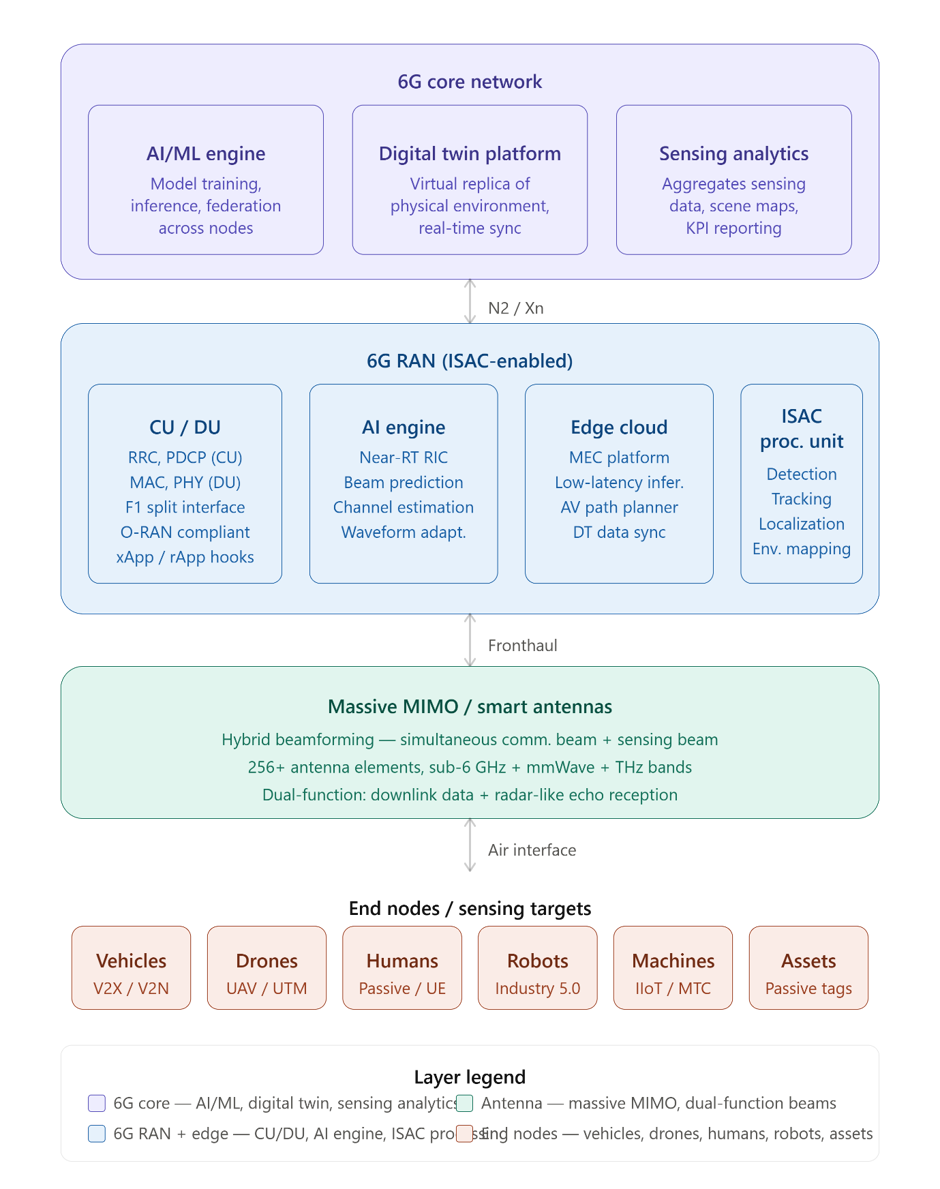
6G core network
The core is the intelligence orchestration layer, running three specialized platforms. The AI/ML engine handles federated model training and distributes inference models to the RAN edge. The digital twin platform maintains a live, synchronized virtual replica of the physical environment — updated in real time from ISAC sensing reports — used for what-if simulation and proactive resource management. The sensing analytics platform aggregates raw sensing KPIs from multiple gNBs into network-wide scene maps, coverage reports, and sensing-as-a-service APIs for vertical applications.
6G RAN ISAC-enabled
This is where the ISAC waveform lives. The CU/DU split follows O-RAN principles: the CU handles RRC/PDCP (including ISAC session management), the DU handles MAC/PHY (including the dual-function waveform scheduling). The RAN-side AI engine runs as a near-RT RIC xApp — it performs beam prediction, channel estimation, and adaptive waveform configuration in under 10 ms. The edge cloud (MEC) co-located with the gNB runs the AV path planner and digital twin synchronization, keeping round-trip latency under 5 ms. The ISAC processing unit executes the four-stage sensing pipeline: detection (CFAR thresholding), tracking (Kalman/particle filter), localization (AoA + ToF fusion for centimeter accuracy), and environment mapping (occupancy grid construction).
Massive MIMO / smart antennas
The antenna array is the physical boundary between waveform and air. With 256+ elements, hybrid beamforming allows the system to simultaneously steer a communication beam at a UE and a sensing beam at a region of interest — both encoded into a single OFDM waveform using DFRC (dual-function radar-communication) techniques. The echo returns enter separate receive ports and are routed to the ISAC processing unit.
End nodes
These are the objects the system both communicates with and senses. Vehicles and drones are active UEs contributing V2X sidelink sensing data cooperatively. Humans, passive assets, and machines are sensing targets — detected purely from reflected echo without requiring any device on their person.
6. Functional Components of ISAC
Communication Function
Responsible for:
User data transmission
QoS management
Mobility management
Beamforming
Sensing Function
Responsible for:
Object detection
Object classification
Localization
Motion estimation
AI Engine
Processes sensed information and enables:
Scene understanding
Object prediction
Behavioral analysis
Digital Twin Engine
Creates virtual representations of physical environments.
7. Key Technology Enablers for ISAC
Massive MIMO
Massive MIMO provides:
Hundreds of antenna elements
Highly directional beams
Spatial diversity
Benefits:
High-resolution sensing
Improved localization
Better tracking accuracy
Massive MIMO effectively turns base stations into large radar arrays.
Millimeter Wave (mmWave)
Frequency range:
24 GHz – 100 GHz
Advantages:
Large bandwidth
High spatial resolution
Enables:
Fine object detection
Accurate imaging
Sub-THz Communications
6G is expected to utilize:
100 GHz – 300 GHz
Benefits:
Extremely large bandwidth
Millimeter-level sensing resolution
Applications:
Industrial automation
Holographic communications
Reconfigurable Intelligent Surfaces (RIS)
RIS consists of programmable reflecting surfaces.
Functions:
Beam steering
Signal enhancement
Reflection control
Benefits for ISAC:
Eliminate sensing blind spots
Improve coverage
Enhance localization accuracy
AI and Machine Learning
AI is the brain of ISAC.
Tasks include:
Object recognition
Environment mapping
Trajectory prediction
Sensor fusion
Without AI, large-scale ISAC would be impractical.
Edge Computing
ISAC generates massive sensing data.
Edge computing provides:
Real-time processing
Reduced latency
Faster decision making
Critical for:
Autonomous driving
Industrial automation
Network Digital Twins
Digital twins maintain virtual replicas of physical environments.
Sensed information continuously updates the twin.
Applications:
Smart cities
Factories
Transportation systems
Joint Waveform Design
Traditional systems use separate waveforms.
ISAC uses unified waveforms supporting:
Communication
Radar sensing
Examples:
OFDM-based ISAC
OTFS-based ISAC
Advanced AI-generated waveforms
8. ISAC Signal Processing Workflow

The diagram shows the complete ISAC signal processing pipeline organized into three functional phases, with a feedback loop from the final AI stage back to the transmitter for closed-loop beam adaptation. Here is what each phase covers:
Transmission phase — the gNB emits a single dual-function waveform (typically OFDM-based, as in 3GPP DFRC proposals) that simultaneously carries a data payload to the user equipment and acts as a radar probe signal. This shared-waveform approach is the defining property of ISAC — no separate radar band or hardware needed.
Reception phase— the reflected echo returns to the gNB's receive array. A matched filter and range-Doppler FFT extract range and velocity for each scatterer. CFAR (constant false alarm rate) thresholding then separates genuine target returns from noise, producing a list of detected objects with range, Doppler, and angle estimates.
Intelligence phase— localization fuses angle-of-arrival and time-of-flight measurements (potentially from multiple cooperative nodes) to yield centimeter-accurate 3D positions. A Kalman or particle filter maintains consistent trajectories across frames. Finally, a deep neural network classifies object type (vehicle, pedestrian, cyclist), estimates velocity vectors, and feeds the result directly into the autonomous vehicle's path planner.
The feedback arc on the left represents adaptive beam management — the AI layer continuously updates the transmit beamforming weights to keep sensing beams pointed at high-priority targets, closing the loop between perception and transmission. Click any stage in the diagram to explore it further.
9. Real-Time Use Cases and Applications
Autonomous Transportation
ISAC enables:
Vehicle-to-everything communication
Pedestrian detection
Collision avoidance
Traffic monitoring
Future roads may rely on cellular ISAC rather than standalone radar systems.
Smart Factories
Industrial environments require:
Worker safety monitoring
Robot coordination
Asset tracking
ISAC provides:
Communication
Positioning
Motion tracking
through one network.
Drone Traffic Management
Urban skies will host thousands of drones.
ISAC supports:
Drone tracking
Collision prevention
Flight path optimization
Healthcare Monitoring
ISAC can monitor:
Heart rate
Breathing patterns
Movement
without wearable devices.
Applications include:
Elderly care
Hospital monitoring
Remote patient observation
Smart Cities
Applications include:
Traffic monitoring
Crowd management
Emergency response
Networks become city-wide sensing platforms.
Extended Reality (XR)
Future XR systems require:
User tracking
Gesture recognition
Spatial awareness
ISAC enables centimeter-level positioning.
Industrial Robotics
Factories require:
Robot localization
Worker detection
Dynamic path planning
ISAC enables safer human-machine collaboration.
Railway Monitoring
ISAC can detect:
Track intrusions
Obstacles
Train movements
Improving transportation safety.
Maritime Monitoring
Applications include:
Ship tracking
Harbor management
Coastal surveillance
Defense and Security
Potential applications:
Battlefield awareness
Target detection
Surveillance
Future military networks may integrate sensing and communication capabilities.
10. ISAC in Autonomous Vehicle Scenario
6G ISAC in an autonomous vehicle scenario integrates radar-style sensing and broadband communication into a single waveform transmitted by the gNB base station — eliminating the need for separate sensing infrastructure.
ISAC Functions:1. Vehicle Communication2. Vehicle Tracking3. Pedestrian Detection4. Velocity Estimation5. Collision Prediction

Here's what each node does:
gNB base station — the central orchestrator. It broadcasts dual-function waveforms that simultaneously carry user data and illuminate the environment for sensing. Channel estimates from the reflected signal are processed to produce a real-time map of vehicle positions, speeds, and even pedestrian locations.
Vehicle A & B (V2X nodes) — each vehicle runs its own on-board radar via ISAC waveforms and shares the extracted sensing data with the gNB and peer vehicles over V2V sidelink (3GPP Rel-17/18 PC5 interface). This cooperative sensing fills blind spots that a single node cannot cover.
Smart traffic signal (V2I) — receives phase and timing advisories from the gNB derived from real-time traffic sensing. It also relays its own detector data back upstream, closing the loop for intersection management.
Pedestrian — a passive sensing target. The gNB and vehicles detect the pedestrian from reflected ISAC waveforms without requiring any device on the pedestrian. The multi-node geometry gives centimeter-accurate localization even around corners (cooperative NLOS sensing, a key 6G feature).
Key ISAC advantage: a single 6G resource block carries both the data payload and the sensing reference signal, cutting spectral overhead and enabling sub-millisecond reaction latency — critical for AV collision avoidance at urban speeds.
11. ISAC Performance Metrics
Key metrics include:
Communication Metrics
Throughput
Spectral Efficiency
Reliability
Latency
Sensing Metrics
Detection Probability
Localization Accuracy
Range Resolution
Velocity Resolution
Tracking Accuracy
Joint Metrics
Sensing-Communication Tradeoff
Energy Efficiency
Resource Utilization
12. Challenges in ISAC
Although promising, ISAC faces significant challenges.
Spectrum Sharing Conflict
Communication and sensing compete for:
Power
Bandwidth
Time resources
Balancing both remains difficult.
Waveform Design Complexity
Waveforms must satisfy:
High communication throughput
Accurate sensing performance
Achieving both simultaneously is challenging.
Hardware Constraints
ISAC requires:
High-speed ADCs
Large antenna arrays
High processing capability
Cost remains a concern.
Synchronization Issues
Accurate sensing requires:
Time synchronization
Frequency synchronization
Errors can significantly degrade performance.
Multi-Target Detection
Dense environments contain:
Vehicles
Humans
Buildings
Drones
Distinguishing multiple targets is difficult.
Privacy Concerns
Networks capable of sensing people raise concerns regarding:
Surveillance
Data collection
User privacy
Future regulations will be required.
Security Risks
Potential threats include:
Sensing spoofing
False target injection
Jamming attacks
New security mechanisms are necessary.
AI Model Complexity
ISAC generates enormous datasets.
Training AI models requires:
High computational resources
Large datasets
Continuous updates
13. ISAC Standardization Activities
Several organizations are actively defining ISAC requirements.
3GPP
Studying:
Integrated sensing use cases
Waveform design
Radio architecture impacts
Likely introduced progressively across future 6G releases.
ITU
Identifies sensing as a major 6G capability.
Next G Alliance
Promoting North American 6G vision including ISAC.
Hexa-X
European flagship 6G initiative actively researching ISAC.
IMT-2030 Promotion Group
China's major 6G research platform with strong ISAC focus.
14. Latest Trends in ISAC
AI-Native ISAC
AI directly controls:
Beamforming
Resource allocation
Object recognition
Cell-Free ISAC
Distributed antennas collaborate for sensing.
Benefits:
Improved coverage
Better localization
RIS-Assisted ISAC
RIS enhances sensing performance in difficult environments.
Semantic ISAC
Networks understand the meaning of sensed information.
Instead of raw data:
Objects
Activities
Intentions
are identified.
Distributed Cooperative Sensing
Multiple base stations jointly sense environments.
Creates a network-wide perception system.
Digital Twin Integration
Real-time digital twins continuously update using ISAC measurements.
THz ISAC
Sub-THz and THz frequencies enable:
Ultra-high-resolution sensing
High-definition environmental imaging
AI-RAN + ISAC
AI-RAN architectures integrate AI processing directly into RAN infrastructure.
This enables:
Real-time perception
Predictive networking
Autonomous optimization
Companies Working on ISAC
Nokia
Research focus:
Hexa-X
6G sensing architecture
AI-enabled ISAC
Ericsson
Developing:
Joint communication-sensing systems
6G radio architecture
Network sensing frameworks
Huawei
Among the most active ISAC researchers.
Focus areas:
THz sensing
AI-native sensing
Smart city applications
Samsung
Researching:
THz communications
Joint radar-communication systems
Qualcomm
Investigating:
Device-based sensing
AI-enabled ISAC platforms
ZTE
Leading multiple 6G sensing research initiatives.
China Mobile
Large-scale ISAC trials and demonstrations.
NTT DOCOMO
Researching:
Human sensing
Smart city applications
Digital twin integration
Keysight Technologies
Developing:
ISAC test platforms
Channel emulation solutions
Rohde & Schwarz
Supporting:
ISAC waveform testing
6G validation environments
15. Future Vision of ISAC
Future 6G networks will not merely connect devices.
They will:
Observe environments
Understand contexts
Predict events
Assist autonomous systems
A 6G base station may simultaneously:
Deliver Tbps connectivity
Detect vehicles
Track drones
Monitor crowds
Update digital twins
This transforms cellular infrastructure into a global sensing platform.
Conclusion
Integrated Sensing and Communications (ISAC) represents one of the most transformative technologies envisioned for 6G. By merging communication and sensing functionalities into a unified platform, ISAC enables wireless networks to become intelligent perception systems capable of understanding and interacting with the physical world.
The convergence of Massive MIMO, AI/ML, RIS, edge computing, digital twins, mmWave, and sub-THz communications creates the technological foundation necessary for large-scale ISAC deployment. Applications span autonomous transportation, smart manufacturing, healthcare, XR, smart cities, defense, logistics, and industrial automation.
Despite challenges involving waveform design, spectrum sharing, hardware complexity, privacy, and security, rapid progress by industry leaders, academia, and standardization bodies suggests ISAC will become a cornerstone capability of 6G networks. The ultimate vision is a world where wireless networks no longer simply transport information but actively sense, understand, and interact with their environments, enabling a truly intelligent and autonomous digital society.
References
1. 3GPP TR 22.837 — Feasibility study on integrated sensing and communication, https://www.3gpp.org/ftp/Specs/archive/22_series/22.837/
2. 3GPP TS 22.137 — Service requirements for ISAC (Release 19), https://www.3gpp.org/ftp/Specs/archive/22_series/22.137/
4. https://arxiv.org/abs/2108.07165, Integrated Sensing and Communications: Toward Dual-Functional Wireless Networks for 6G and Beyond
5. Wei et al. — "Toward deeper environmental understanding: event-level sensing for intelligent 6G ISAC" (arXiv 2606.14223, 2025)


Comments