

Massive MIMO in 5G

1. Introduction
The exponential growth in mobile data traffic, driven by 4K/8K video, cloud gaming, AR/VR, industrial IoT, and private 5G networks, has forced wireless systems to evolve beyond traditional antenna systems. One of the most transformative technologies enabling 5G performance is Massive MIMO (Multiple Input Multiple Output).
Unlike conventional MIMO (2x2, 4x4, 8x8), Massive MIMO scales antenna elements to tens or even hundreds at the base station, enabling spatial multiplexing and beamforming with unprecedented precision.
2. Evolution of MIMO
2.1 SISO → MIMO → Massive MIMO
Generation | Antenna Type | Typical Config |
2G | SISO | 1x1 |
3G | Diversity | 2x2 |
4G LTE | MIMO | 2x2, 4x4, 8x8 |
5G NR | Massive MIMO | 32T32R, 64T64R, 128T128R |
In LTE, spatial multiplexing allowed multiple streams to be transmitted to a single user. But interference and correlation limited scalability.
Massive MIMO changes the paradigm: "Instead of fighting interference, it exploits spatial dimensions to suppress it."
3. Fundamentals of Massive MIMO
3.1 Basic Concept
Massive MIMO uses:
Large number of antenna elements (M)
Serves multiple users (K)
M >> K
For example:
64 antennas serving 8–16 users simultaneously
This creates:
High spatial resolution - Massive MIMO uses a large number of antenna elements spaced roughly at half-wavelength, forming a large effective aperture. A larger aperture improves angular discrimination, allowing the gNB to distinguish users separated by only a few degrees in space. Mathematically, spatial resolution improves as antenna count M increases.
· Narrow beams- By coherently adjusting phase and amplitude across many antennas, the array forms constructive interference in a desired direction and destructive interference elsewhere. As the number of antennas increases, the main lobe becomes sharper and side lobes reduce. Beamwidth roughly decreases as 1/M, resulting in highly directional transmission.
Interference suppression - With accurate channel knowledge, precoding (e.g., Zero-Forcing or MMSE) shapes transmitted signals so they cancel out at unintended users while reinforcing at the target UE. Because user channels become nearly orthogonal when M ≫ K, inter-user interference naturally reduces. This spatial filtering significantly improves SINR in dense deployments.
3.2 Channel Model Intuition
Received signal:
y=Hx+ny =Hx+n
Where:
y = received vector
H = channel matrix (M × K)
x = transmitted signal
n = noise
As M → large:

This means:
Channels become orthogonal
Inter-user interference reduces
Linear processing becomes near-optimal
This is known as channel hardening.
4. How Massive MIMO Works in 5G NR
4.1 System Architecture
Massive MIMO architecture in 5G is not just “many antennas.” It is a distributed signal processing system that spans baseband, fronthaul, RF chains, and antenna arrays, all tightly synchronized.
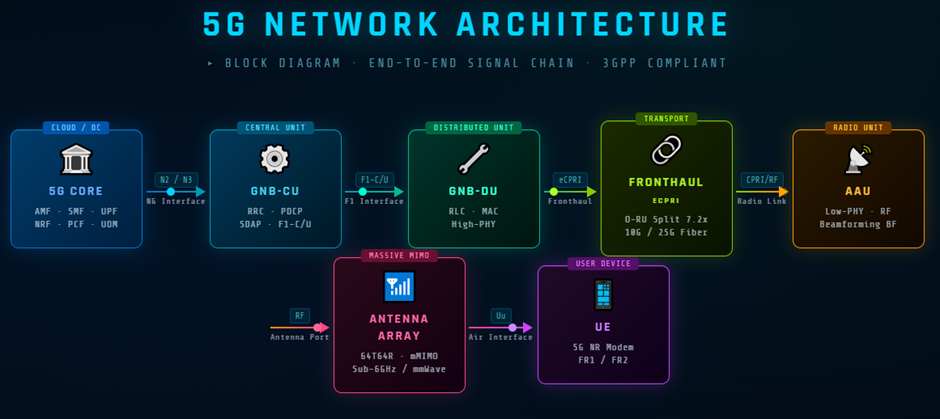
Massive MIMO processing mainly resides in:
Distributed Unit (DU) → PHY layer processing
Active Antenna Unit (AAU) → RF + beamforming
1. Massive MIMO is implemented inside Active Antenna Units (AAU)
An Active Antenna Unit (AAU) is an integrated 5G radio system that combines:
Antenna array
RF transceivers
Power amplifiers (PA)
Low-noise amplifiers (LNA)
Digital beamforming circuitry
into a single compact unit, typically mounted directly on the tower.
Traditional (Passive Antenna + Remote Radio Unit)

Antenna is passive (no active electronics inside)
RF processing done in separate RRU
Long RF feeder cables
Limited to fixed radiation patterns
Parameter | Traditional Antenna | Active Antenna Unit (AAU) |
RF chains | In external RRU | Integrated in panel |
Beamforming | Mechanical / fixed tilt | Digital & dynamic |
Antenna elements | 2–8 typical | 32–128 typical |
Feeder loss | High (long cables) | Minimal |
Massive MIMO support | No | Yes |
Power efficiency | Lower | Higher (array gain) |
2. Digital beamforming + RF chains integrated
Each antenna element has its own complete transmit/receive RF path, and beamforming is done digitally in baseband before RF conversion.
Digital beamforming happens before DAC, in the baseband processor.
Let:

Where:
M = antennas (e.g., 64)
K = users (e.g., 12)
The precoder computes:
x=Ws
Where:
s = user symbols
W = precoding matrix
x = 64 weighted signals
Each antenna gets its own weighted IQ stream.
Parallel RF Chains
Each stream goes to:
Dedicated DAC
Dedicated mixer
Dedicated power amplifier
So antenna 1 transmits ,antenna 2 transmits , etc.
All signals combine in space.
If RF chains were shared (analog beamforming):
Only 1 beam possible
No independent streams
Integrated RF chains allow:
Number of simulataneous beams <= Number of RF chains
So 64 RF chains enable true multi-user MIMO.
3. Common configurations:
32T32R
64T64R
128T128R (mmWave)
Detailed Massive MIMO Signal Chain
Let’s follow a downlink data path.
Step 1: Baseband Processing (DU)
Inside DU:
1. Channel coding (LDPC/Polar)
2. Rate matching
3. Scrambling
4. Modulation (QPSK/16QAM/64QAM/256QAM)
5. Layer mapping
6. Precoding matrix computation
Precoding matrix:

Where:
H = estimated channel matrix
W = M × K beamforming matrix
This stage decides spatial multiplexing.

Step 2: Fronthaul Interface
DU sends IQ samples over:
CPRI (legacy)
eCPRI (packet-based)
Important parameters:
High bandwidth requirement
Low latency
Tight synchronization (PTP, SyncE)
Massive MIMO increases fronthaul load significantly.

Step 3: AAU Digital Processing
Inside AAU:
Digital beamforming
IFFT (OFDM generation)
Cyclic prefix insertion
Digital predistortion (DPD)
Calibration compensation
For each antenna port:

Each antenna transmits a weighted version of user signals.

Step 4: RF Chain
Each antenna element has:
DAC
Mixer
Local oscillator
Power amplifier
Bandpass filter
For 64T64R system:
64 transmit RF chains
64 receive RF chains
This is why AAU is power-hungry and thermally complex.

4.2 Uplink Operation

UE transmits SRS (Sounding Reference Signal)
SRS (Sounding Reference Signal) is an uplink reference signal transmitted by the UE to allow the gNB to estimate the uplink channel across wide bandwidth.
It is:
Uplink only
Configured by RRC
Periodic or aperiodic
Frequency domain comb-based
Wideband or subband
In conventional LTE:
Channel estimation mainly per-user, limited antennas.
In Massive MIMO:
gNB has 32/64/128 antennas
Needs full spatial channel vector per user
Must estimate amplitude + phase per antenna
If M = 64 antennas,Channel vector per UE:

Each UE must transmit orthogonal SRS so that gNB can isolate individual channel responses.
gNB estimates uplink channel
After SRS reception:
Received signal at antenna m:

Stacked across M antennas:

Where:
H = M × K channel matrix
K = number of UEs
The gNB performs:
Correlation with known SRS sequence
Least Squares (LS) estimation
Or MMSE estimation
Channel estimate:Where:
H = M × K channel matrix
K = number of UEs
The gNB performs:
Correlation with known SRS sequence
Least Squares (LS) estimation
Or MMSE estimation
Channel estimate:

Channel Hardening
When M is large:

Meaning:
Inter-user channels become orthogonal
Noise averages out
Small-scale fading reduces impact
This makes linear precoding very effective.
Using TDD reciprocity, downlink channel is inferred
In TDD:
UL and DL use same frequency band
Channel is reciprocal (if calibrated)

So:
No need for DL CSI feedback
No codebook overhead
No massive feedback burden
However, RF chains are not reciprocal.
Transmitter and receiver RF chains differ:

Hence:
Calibration circuits are required
Over-the-air calibration used
Internal reference loops implemented
If calibration fails:
Beamforming accuracy degrades
Interference increases
4. Precoding weights computed
Once channel matrix H is known, gNB computes precoding matrix W.
Downlink signal:

Where:
W = M × K precoding matrix
Common Precoding Methods
Maximum Ratio Transmission (MRT)

Maximizes signal strength
Low complexity
Does not cancel interference fully
It says "Transmit in the exact direction of the user’s channel."
For user k:

This maximizes received signal power.
Zero Forcing (ZF)

Cancels inter-user interference
Requires matrix inversion
Computationally heavy
Minimum Mean Square Error (MMSE)

Balances:
Noise
Interference
Signal power
Best performance but highest complexity.
Feature | MRT | ZF | MMSE |
Signal maximization | Yes | Moderate | Yes |
Interference cancellation | No | Yes | Yes |
Noise robustness | Good | Weak | Strong |
Matrix inversion | No | Yes | Yes |
Complexity | Low | Medium | High |
Used in real 5G | Yes (low load) | Yes (common) | Yes (high-end systems) |
Computational Challenge
For 64 antennas and 16 users:
Matrix inversion size: 16 × 16 per PRB group
Requires:
FPGA / ASIC acceleration
Parallel matrix engines
Optimized linear algebra cores
Spatially multiplexed downlink beams transmitted
After precoding:
Each antenna transmits weighted signal:

What happens in space?
Beams constructively add toward intended UE
Beams destructively cancel toward others
Multiple users served in same time-frequency resource
This is Multi-User MIMO (MU-MIMO).
4.3 Beamforming Types
1. Analog Beamforming
Single RF chain
Phase shifters
Used in mmWave
2. Digital Beamforming
One RF chain per antenna
Full flexibility
Used in sub-6 GHz
3. Hybrid Beamforming
Combination
Reduced hardware complexity
Type | Used Where | Multi-User | Complexity | Typical Deployment |
Analog | mmWave | No | Low | Small cells |
Digital | Sub-6 | Yes | High | 64T64R macro |
Hybrid | mmWave | Limited | Medium | 128T arrays |
5. Key Design Aspects
5.1 Antenna Array Design
In Massive MIMO, antenna array design directly determines:
Beam sharpness
Spatial resolution
Interference suppression
Coverage footprint
Hardware feasibility
Unlike traditional 2T2R systems, array design in Massive MIMO (32T, 64T, 128T) is a core performance driver, not just a mechanical structure.
Important parameters:
Array geometry (linear vs planar)
Linear Array
Antennas arranged in one dimension (e.g., vertical column)
Provides beam steering in one plane (typically azimuth OR elevation)
Limited 3D control
Used in:
Early LTE beamforming
Simpler deployments
Planar Array (2D Array)
Antennas arranged in rows and columns (e.g., 8×8, 16×8)
Enables 3D beamforming
Azimuth steering
Elevation steering
Why 5G prefers planar arrays:
Urban high-rise environments require vertical beam shaping
Multi-floor coverage
Better spatial multiplexing
Example:64T64R → typically 8×8 dual-pol planar array.
Element spacing (~ λ/2)
Spacing between antenna elements is typically: d ~ λ/2
Where:
λ = wavelength
At 3.5 GHz → λ ≈ 8.5 cm → spacing ≈ 4.2 cm
Why λ/2?
If spacing < λ/2:
Strong mutual coupling
Correlation increases
Reduced spatial diversity
If spacing > λ:
Grating lobes appear
Unwanted beams form
Coverage distortion
λ/2 provides:
Optimal spatial sampling
No grating lobes
Good beam control
In Massive MIMO:Correct spacing ensures clean narrow beams and proper spatial multiplexing.
Polarization (±45° dual pol)
Modern 5G arrays use:
Cross-polarized elements
Typically +45° and −45°
Benefits:
1. Doubles effective antenna ports in same physical area
2. Improves MIMO rank
3. Reduces polarization mismatch loss
4. Enhances diversity
In 64T64R:
32 physical positions
Each with dual polarization
Total 64 ports
This allows:
Better channel decorrelation
Improved MU-MIMO performance
Mutual coupling
Mutual coupling = electromagnetic interaction between nearby antenna elements.
When one antenna transmits, it induces current in neighboring elements.
Why it matters in Massive MIMO
If coupling is high:
Channel correlation increases
Beamforming accuracy reduces
Calibration becomes harder
Radiation pattern distortion occurs
In large arrays, cumulative coupling effects can degrade performance significantly.
Mitigation Techniques
Proper λ/2 spacing
Decoupling structures
Ground plane optimization
Electromagnetic simulation tuning
Massive MIMO arrays require advanced EM modeling during design.
Radiation efficiency
Radiation efficiency = Radiated Power / Input Power
Loss sources:
Dielectric losses
Conductor losses
Matching network loss
Housing materials
Parameter | Impacts |
Geometry | Beam steering capability |
Spacing | Grating lobes & resolution |
Polarization | Channel rank & diversity |
Mutual coupling | Channel correlation |
Efficiency | Power & thermal performance |
5.2 RF Chain & Power Amplifier Design
In Massive MIMO (e.g., 64T64R), every antenna element has its own RF chain and power amplifier (PA).So instead of designing one high-power transmitter, we design 64 medium/low-power transmitters working coherently.
In a 64T64R AAU:
64 DACs
64 mixers
64 PAs
64 antenna elements
Now let’s understand the design challenges.
Challenges:
Linearity vs efficiency
Why Linearity Matters
5G uses high-order modulation:
64QAM
256QAM
These constellations require:
Low distortion
Low EVM
Good ACLR (Adjacent Channel Leakage Ratio)
If PA is nonlinear:
Constellation spreads
EVM increases
Spectral regrowth occurs
Adjacent channel interference increases
Why Efficiency Matters
Power amplifier efficiency:

In Massive MIMO:
64 PAs running simultaneously
Even small inefficiency multiplies power consumption
If each PA is 30% efficient:Large heat generation occurs.
The Core Trade-Off
High Linearity | High Efficiency |
Requires PA to operate in linear region | Requires PA to operate near saturation |
Lower distortion | More distortion |
Lower efficiency | Higher efficiency |
Operating near saturation improves efficiency but worsens linearity.
Massive MIMO Advantage
Instead of one 40W PA (LTE style),Massive MIMO may use 64 × 1W PAs.
Because of array gain, each PA can run at lower output power while achieving high EIRP.
This allows:
Use of more efficient PA classes (e.g., Doherty)
Lower stress per PA
PAPR of OFDM
What is PAPR?
5G NR uses OFDM.
OFDM signals can have: PAPR around 8 -12dB
Meaning:
Peak power is 10× average power.
Why This Is a Problem
If PA saturates at peak:
Signal clipping occurs
Severe distortion
EVM violation
ACLR failure
So PA must operate with back-off: Poperating= Pmax-PAPR
If PAPR = 10 dB:PA must operate 10 dB below saturation.
This drastically reduces efficiency.
Example
Suppose:
PA saturation power = 10 W
PAPR = 10 dB
Then average usable power = 1 W.
Efficiency collapses.
Massive MIMO Impact
Since each antenna transmits lower power:
Required absolute peak power is smaller
Device stress reduces
PA technology becomes more feasible
Thermal management
In a 64T64R AAU:
If each PA dissipates even 3–5 W of heat:
64x5=320W of heat
That is significant.
Why It’s Harder Than LTE
Traditional LTE:
PA in separate RRU
Easier cooling
Massive MIMO AAU:
RF + antenna integrated
Compact panel
Mounted outdoors
Sun exposure
No large cooling fans
Digital predistortion (DPD)
What is DPD?
DPD compensates PA nonlinearity digitally.
Instead of:
Nonlinear PA → distorted output
We apply inverse distortion before PA:

So after PA nonlinearity:

Why DPD is Critical in Massive MIMO
Each PA behaves slightly differently.
In 64T system:
64 separate nonlinear devices
Need calibration per branch
Without DPD:
EVM increases
ACLR fails
Spectral mask violations
Challenge
Running 64 DPD engines:
Heavy DSP load
Power consumption
Real-time adaptation required
Vendors implement:
Per-branch DPD
Grouped DPD
AI-based DPD
Massive MIMO reduces required per-antenna power because beamforming provides array gain.
5.3 Channel State Information (CSI)
In Massive MIMO, Channel State Information (CSI) is the mathematical description of how signals propagate between each transmit antenna and each UE.
If the gNB has M antennas and serves K users, the channel is:

Every column represents the spatial channel of one UE across all antennas.
CSI acquisition is critical.
In:
TDD → Channel reciprocity used
In TDD:
Uplink and downlink use the same frequency band
Channel propagation is reciprocal (over short time scales)
Meaning:

So if gNB estimates the uplink channel, it automatically knows the downlink channel.
FDD → Feedback overhead becomes huge
In FDD:
Uplink and downlink use different frequency bands
Channels are not reciprocal
So uplink channel ≠ downlink channel.
The gNB must:
1. Transmit CSI-RS (reference signals)
2. UE estimates DL channel
3. UE feeds back CSI:
PMI (Precoding Matrix Indicator)
RI (Rank Indicator)
CQI (Channel Quality Indicator)
The Massive MIMO Problem in FDD
If:
M = 64 antennas
UE must report channel vector of length 64
Feedback size becomes huge.
For each UE:
So if antenna count doubles, feedback doubles.
With 64 or 128 antennas:
Feedback overhead explodes
UL control channel congests
Latency increases
This is why Massive MIMO scales better in TDD systems.
6. Performance Benefits
6.1 Spectral Efficiency
Theoretical sum capacity:
C=Klog2(1+SINR)
With M antennas:
SINR∝MSINR ∝M
Thus:
5x–10x capacity improvement over LTE
High cell-edge throughput
6.2 Energy Efficiency
Array gain:
Gain=10log10(M)
For 64 antennas:
Gain≈18dB
This reduces:
Required transmit power
Interference leakage
6.3 Coverage Improvement
Narrow beams:
Improve SINR at cell edge
Enable deep indoor coverage
Reduce pilot contamination
7. Real-Time Deployment Scenarios
7.1 Sub-6 GHz Urban Macro
Typical:
64T64R
3.5 GHz band (n78)
TDD mode
100 MHz bandwidth
Benefits:
High traffic density support
Beam steering in crowded zones
7.2 mmWave Deployment
Characteristics:
28 GHz / 39 GHz
128+ antennas
Very narrow beams
Short range
Used in:
Stadiums
Airports
Smart factories
7.3 Private 5G & Industry 4.0
Massive MIMO enables:
Deterministic latency
Ultra-reliable links
Spatial isolation for robots
Used in:
Automated warehouses
Smart ports
Oil & gas fields
8. Practical Challenges
8.1 Pilot Contamination
Occurs when:
Same pilot reused in neighboring cells
Channel estimation interference
Mitigation:
Smart pilot allocation
Coordinated scheduling
Cell-free architectures
8.2 Hardware Impairments
Phase noise
IQ imbalance
Non-linear PA distortion
Calibration mismatch
Large arrays require tight calibration.
8.3 Computational Complexity
Matrix inversion in ZF:

For large M:
DSP load high
Requires FPGA / ASIC acceleration
9. Massive MIMO in 3GPP 5G NR
Standardized in:
3GPP Release 15+
Codebook-based and non-codebook precoding
Type I / Type II CSI feedback
Beam management procedures
Important features:
SRS-based beamforming
CSI-RS for channel estimation
Beam sweeping & refinement
10. Use Cases Enabled by Massive MIMO
Use Case | Benefit |
eMBB | High throughput |
URLLC | Spatial reliability |
mMTC | User separation |
FWA | Fiber-like wireless |
Smart cities | High user density |
11. Massive MIMO vs Traditional MIMO
Parameter | LTE MIMO | Massive MIMO |
Antennas | 2–8 | 32–128 |
Beamforming | Limited | 3D beamforming |
Spatial Multiplexing | Per user | Multi-user |
Energy Efficiency | Moderate | High |
Interference | Significant | Suppressed |
12. Field Performance Observations
From live networks:
3–5x cell throughput gain
40–60% improved spectral efficiency
30–50% better cell edge SINR
Reduced inter-cell interference
Operators deploy Massive MIMO primarily in:
High-density urban areas
High-bandwidth TDD spectrum
13. Future Evolution Toward 6G
Future enhancements:
Extremely Large MIMO (EL-MIMO)
Cell-free Massive MIMO
AI-driven beamforming
Reconfigurable Intelligent Surfaces integration
Terahertz band massive arrays
Massive MIMO will evolve into intelligent spatial computing systems.
14. Conclusion
Massive MIMO is not just an antenna scaling technique — it is the spatial foundation of 5G.
It provides:
Order-of-magnitude capacity gains
Improved coverage
Energy efficiency
Multi-user interference suppression
Without Massive MIMO, 5G’s promised performance would not be achievable in practical deployments.
As networks evolve toward 6G, Massive MIMO will become even more intelligent, distributed, and adaptive — transforming wireless communication into a highly directional, software-defined spatial system.
15. References
1. Industry explanation of Massive MIMO basics, https://www.ericsson.com/en/ran/massive-mimo
2. ML/AI research in Massive MIMO and antenna arrays, https://www.mdpi.com/2078-2489/15/8/442
3. Comprehensive survey on Massive MIMO techniques, https://www.mdpi.com/2079-9292/10/14/1667
4. Academic precursor on massive MIMO system theory, https://arxiv.org/abs/1605.03426
5. Technical description of Zero Forcing precoding (core algorithm in Massive MIMO), https://en.wikipedia.org/wiki/Zero-forcing_precoding
6. Systematic study of Massive MIMO design and challenges, https://ietresearch.onlinelibrary.wiley.com/doi/10.1049/cmu2.12180


Comments