

CSI-RS in 5G NR

What is CSI-RS and why it’s used
Channel State Information Reference Signal (CSI-RS) is a configurable downlink reference signal used by the gNB to enable precise channel measurements for beamforming, link adaptation, mobility, and synchronization tasks in 5G NR.
The key parameters reported in a 5G NR CSI report are CQI, RI, PMI, CRI/SSBRI, optional LI, and optionally L1-RSRP/L1-SINR, delivered via a configured report (Part1/Part2) tied to specific CSI-RS/SSB and CSI-IM resources; the gNB uses these to pick MCS, layers, precoders/beams, and frequency-time resources for scheduling each UE. In short, CSI drives link adaptation: CQI guides robust MCS, RI/LI selects spatial layers, PMI/CRI selects beams/precoders, and power/quality metrics refine resource and HARQ strategies.
How gNB uses CSI
MCS selection: Uses CQI (conditioned on assumed bundling and codebook) to choose modulation and coding per bandwidth part/prg for target BLER, balancing throughput and reliability.
Beamforming/precoding: Maps PMI to a codebook entry and aligns transmit beam to the CRI/SSBRI-referenced CSI-RS/SSB, improving SINR and interference rejection. Beam management refinement beyond SSB-based initial access (beam measurement and selection).
Layer allocation: Sets the number of streams based on RI and uses LI to map codeword-to-layer and PT-RS/PDCCH settings, optimizing spatial multiplexing vs. robustness.
· Connected-mode mobility (handover triggers using CSI-RSRP/RSRQ/SINR).
· Radio link and beam failure detection/recovery signaling at PHY/MAC.
· Fine time/frequency tracking via TRS (Tracking RS) realized using CSI-RS patterns with high RE density.
Frequency-domain granularity: Applies wideband vs. subband CQI/PMI when configured to schedule PRBs/PRGs on stronger subbands and avoid weak ones.
HARQ and power control context: Adapts redundancy versions, code rates, and may bias allocations by reported L1-RSRP/quality and interference resources (CSI-IM).
Key characteristics of CSI
Up to 32 antenna ports can be configured for CSI-RS; ports map to beams or spatial layers to be “sounded”.
Time/frequency patterns are flexible; CSI-RS resources are grouped into resource sets and scheduled periodically, aperiodically, or semi-persistently through higher-layer signaling.
For time/frequency tracking (TRS), a single-port, high-density mapping (e.g., 3 RE/RB) enhances estimation of CFO/TO with rate-matching to avoid collisions with neighboring PDSCH.
In short, CSI-RS provides the high-resolution, configurable “channel sounding” needed for accurate downlink precoding and robust operation in mmWave/sub-6 GHz with massive MIMO.

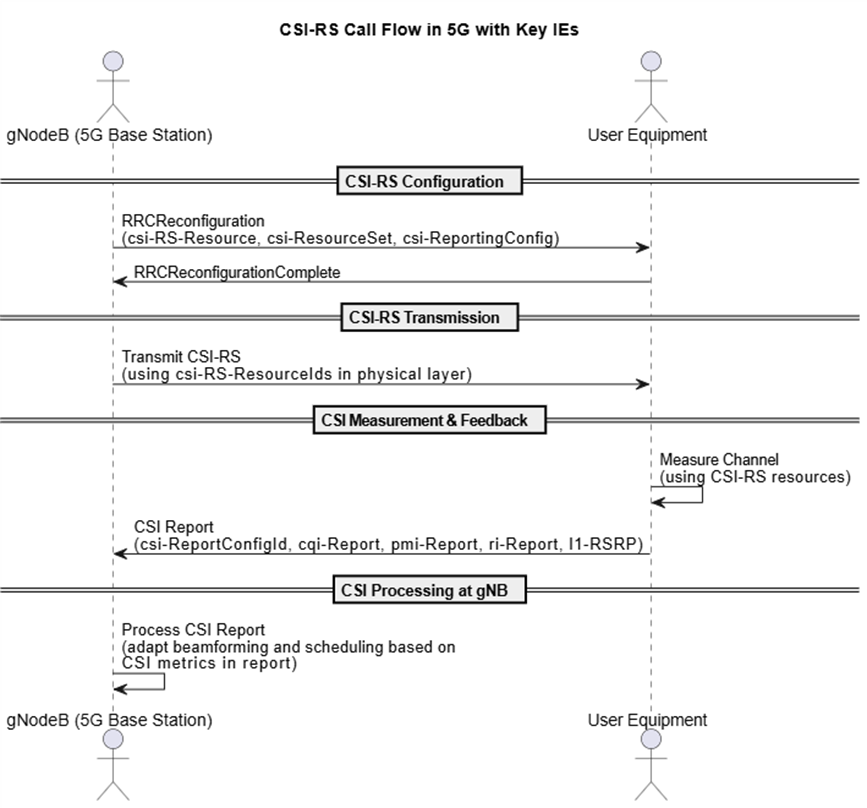
gNB and UE message flow for CSI
Resource acquisition
UE decodes RRC signaling for CSI-RS/CSI-IM resource sets, periodicity, ports, and measurement/report configuration.
Channel estimation
Using NZP-CSI-RS REs per port, UE estimates the channel H for each antenna port/beam across configured RBs and symbols.
Interference/noise estimation
Using CSI-IM (and CSI-RSSI in CSI-RS symbols), UE derives interference-plus-noise power spectral density for SINR computation and CQI mapping.
Compute feedback quantities
CQI: map post-precoding SINR (with assumed or codebook precoder) to a recommended MCS per 38.214.
RI: evaluate channel rank via eigenvalues/singular values of H across subbands/bandwidth; pick preferred layers.
PMI: search codebook for the precoder maximizing expected throughput/SE (e.g., capacity or effective SINR metric), considering Type I/II configuration.
Report construction and transmission
Assemble CSI payload (e.g., wideband or subband CQI, wideband or subband PMI, RI; potentially partial/reduced variants) following report configuration and periodicity; send on PUCCH or PUSCH.
gNB scheduling
gNB applies reported CQI/PMI/RI to choose MCS, layers, beams, and grants for PDSCH/PDCCH, closing the adaptation loop.
CSI-RS types, ports, and structure

NZP-CSI-RS (non-zero power): This is the primary signal used for channel measurement. The UE measures NZP CSI-RS to estimate the channel quality and reports parameters like Channel Quality Indicator (CQI), Rank Indicator (RI), and Pre-coding Matrix Indicator (PMI). It is also used for beam management and mobility measurements like CSI-RSRP (Reference Signal Received Power).
Channel Measurement (CM) Applications:
a. CSI feedback generation (CQI/PMI/RI reporting) for downlink adaptation
b. Beam management and beam refinement beyond initial SSB-based access
c. Connected-mode mobility measurements (handover triggers)
d. Radio link failure (RLF) detection and beam failure recovery
e. Fine time and frequency synchronization tracking
Interference Measurement (IM) for MU-MIMO:
In multi-user MIMO scenarios, NZP-CSI-RS resources are configured for intra-cell interference measurement. For example, when three UEs share the same resource blocks, each UE is configured with:
2 NZP-CSI-RS resources for interference measurement (IM)
1 NZP-CSI-RS resource for channel measurement (CM)
This allows UEs to measure interference levels generated when transmissions are scheduled toward other UEs, enabling accurate CQI reports that reflect MU-MIMO radio conditions.
2. ZP-CSI-RS (zero power): For these resources, the gNB transmits no signal power. ZP CSI-RS has three main use cases :
Rate matching for PDSCH: It informs the UE which resource elements to ignore when decoding the Physical Downlink Shared Channel (PDSCH), which is useful when the data to be sent doesn't fill all allocated resources.
Interference measurement protection: When configured as CSI-IM, it allows the UE to measure interference from other cells.
Beam mobility support: Used in beam switching scenarios where beams alternate between zero and non-zero power
Configuration Location:
Unlike NZP-CSI-RS which is configured within CSI-ReportConfig, ZP-CSI-RS is configured within PDSCH-Config, indicating its tight association with data scheduling.
3. CSI-IM (interference measurement): These are resources specifically configured for the UE to measure inter-cell interference. CSI-IM resources are essentially ZP CSI-RS resources that are configured to align with the data transmissions of neighboring cells, allowing the UE to measure the interference power.
Purpose and Operation:
The serving cell transmits no power on CSI-IM resource elements
UEs measure background interference from neighboring cells during these "silent" periods
Enables accurate interference estimation for CSI computation, particularly CQI calculation
Physical Structure:
Pattern 0: 2×2 grid of resource elements
Pattern 1: 4×1 grid of resource elements

The behavior of CSI reporting is controlled by RRC (Radio Resource Control) messages from the gNB to the UE. Key configuration objects found in UE logs are CSI-ReportConfig and CSI-ResourceConfig.
CSI-ReportConfig
This configuration specifies what to report, how to report it, and when to report it.
reportConfigId: A unique identifier for the specific report configuration.
resourcesForChannelMeasurement: An ID that links this report configuration to a specific CSI-ResourceConfig where the CSI-RS resources are defined.
reportQuantity: Defines the information the UE should report. Common values include:
cri-RI-PMI-CQI: For detailed channel feedback (CSI-RS Resource Indicator, Rank Indicator, Pre-coding Matrix Indicator, Channel Quality Indicator).
ssb-Index-RSRP: For mobility, reporting the RSRP of Synchronization Signal Blocks.
reportFreqConfiguration: Controls how often the reports are sent (e.g., periodic, aperiodic).
csi-resourceConfig
This configuration defines the physical resources (time and frequency) for the CSI-RS.
csi-ResourceConfigId: An identifier that links to a CSI-ReportConfig.
csi-RS-ResourceSetList: A list that can contain NZP CSI-RS, ZP CSI-RS, or CSI-IM resource sets.
Resource Mapping: Specifies the exact location of the CSI-RS in terms of OFDM symbols and subcarriers within a radio frame
NZP CSI-RS for Channel Measurement
In this scenario, the gNB configures an NZP CSI-RS resource for the UE to perform channel measurements and report back detailed CSI.
// Report Configuration for NZP-CSI-RS
CSI-ReportConfig ::= {
reportConfigId = 1,
resourcesForChannelMeasurement = 10,
reportQuantity = 'cri-RI-PMI-CQI',
reportType = 'periodic',
pucch-Resource = 5
}
// Resource Configuration for NZP-CSI-RS
CSI-ResourceConfig ::= {
csi-ResourceConfigId = 10,
csi-RS-ResourceSetList = {
nzp-CSI-RS-ResourceSet = {
nzp-CSI-RS-ResourceSetId = 1,
nzp-CSI-RS-Resources = {
nzp-CSI-RS-ResourceId = 1,
resourceMapping = {
frequencyDomainAllocation = 'row1',
nrofPorts = 4,
firstOFDMSymbolInTimeDomain = 4,
cdm-Type = 'cdm-2',
density = 'one'
},
powerControlOffset = 0
}
}
}
}
ZP CSI-RS for PDSCH Rate Matching
Here, a ZP CSI-RS resource set is configured to inform the UE about resource elements that will not contain PDSCH data. This is typically referenced within the PDSCH configuration.
// PDSCH configuration referencing a ZP-CSI-RS resource set
PDSCH-Config ::= {
...
rateMatchPatternToAddModList = {
{
rateMatchPatternId = 2,
patternType = {
resourceBlocks = {
zp-CSI-RS-ResourceSetId = 20
}
}
}
}
}
// ZP-CSI-RS Resource Set Configuration
CSI-ResourceConfig ::= {
csi-ResourceConfigId = 15, // A different ID for a different purpose
csi-RS-ResourceSetList = {
zp-CSI-RS-ResourceSet = {
zp-CSI-RS-ResourceSetId = 20,
zp-CSI-RS-ResourceIdList = { 2, 3 }
}
}
}
ZP CSI-RS as CSI-IM for Interference Measurement
In this example, CSI-IM resources are configured for interference measurement. The UE measures the signal power on these "zero-power" resource elements to estimate the interference level from other cells.
// Report Configuration for Interference Measurement
CSI-ReportConfig ::= {
reportConfigId = 3,
resourcesForChannelMeasurement = 30,
reportQuantity = 'cri-RSRP', // UE measures interference (RSSI) on these resources
reportType = 'aperiodic'
}
// Resource Configuration for CSI-IM
CSI-ResourceConfig ::= {
csi-ResourceConfigId = 30,
csi-RS-ResourceSetList = {
csi-IM-ResourceSet = {
csi-IM-ResourceSetId = 3,
csi-IM-ResourceList = {
csi-IM-ResourceId = 101,
resourceMapping = { ... } // Specifies REs for interference measurement
}
}
}
}
Resource allocation and signaling (high-level)
CSI-RS configuration is delivered via higher layers (RRC) defining:
Which resources/ports belong to NZP and CSI-IM sets, periodicity/offset, time-domain locations, and frequency-domain patterns.
CSI-Meas/Report configuration: what to measure (e.g., CSI-RSRP/RSRQ/SINR), report type/periodicity, and feedback quantities (CQI/PMI/RI) with codebook type.
The UE receives: “CSI Report Config” → “CSI-RS Resource Set” → “CSI-RS Resources,” mapping physical REs to antenna ports and report recipes (periodic/semi-persistent/aperiodic).
CSI-RS Port Structure and Capabilities
Port Numbering and Maximum Configuration
CSI-RS supports up to 32 antenna ports numbered 3000-3031 :
Port Range Mapping:
4 ports: 3000-3003
8 ports: 3000-3007
12 ports: 3000-3011
16 ports: 3000-3015
24 ports: 3000-3023
32 ports: 3000-3031

Example from a UE Log
Below is a representation of how these parameters might appear in a decoded UE log snippet. The log shows the RRC message CSI-ResourceConfig, which contains the configuration for a Non-Zero Power (NZP) CSI-RS resource.
// RRC Reconfiguration Message
...
csi-MeasConfig
csi-ResourceConfigToAddModList
item 0
csi-ResourceConfig
csi-ResourceConfigId: 1
csi-RS-ResourceSetList: nzp-CSI-RS-SSB
resourceSetType: periodic
nzp-CSI-RS-ResourceSet
nzp-CSI-RS-ResourceSetId: 0
nzp-CSI-RS-Resources
item 0
nzp-CSI-RS-ResourceId: 0
resourceMapping
frequencyDomainAllocation: row1 (0)
nrofPorts: p8 // <-- Number of CSI-RS Ports is 8
firstOFDMSymbolInTimeDomain: 4
cdm-Type: fd-CDM2 // <-- CDM Type is fd-CDM2
density: three (1)
freqBand
startingRB: 0
nrofRBs: 52
powerControlOffset: 0
powerControlOffsetSS: db0
...
nrofPorts (Number of Ports): This field directly tells you the number of CSI-RS ports being configured for a specific resource. The number of ports can range from 1 to 32. The value can be p1, p2, p4, p8, p12, p16, p24, or p32.
cdm-Type: This field specifies the Code Division Multiplexing scheme used. CDM allows multiple antenna ports to share the same time-frequency resources. The possible values for cdm-Type are:
noCDM: No CDM is applied. Each port has its own unique resource element.
fd-CDM2: Frequency Division CDM with a length of 2. Two ports are multiplexed over two adjacent subcarriers.
cdm-4: CDM with a length of 4, combining both time and frequency domain resources (fd-CDM2 and td-CDM2).
cdm-8: CDM with a length of 8, for a higher number of ports.
In this example:
The nrofPorts field is set to p8, which means 8 CSI-RS ports are configured for this resource.
The cdm-Type is fd-CDM2, indicating that Frequency Division CDM of length 2 is used. This means that pairs of antenna ports are multiplexed onto adjacent subcarriers.
Measurements from CSI-RS for mobility and beam management
3GPP defines CSI-based RRM measurements, typically over specified bandwidth:
CSI_RSRP: CSI-RSRP (Reference Signal Received Power) measurements are used for connected mode mobility, power control calculations, and beam management. Measurements can be generated and reported at both layer I and layer 3. For example, a UE can provide CSI-RSRP measurements at Layer I when sending CSI to the BS. Alternatively, a UE can provide CSI-RSRP measurements at Layer 3 when sending an RRC Measurement Report. CSI-RSRP represents the average power received from a single RE allocated to the CSI-RS. Measurements are filtered at Layer 1 to help remove the impact of noise and to improve measurement accuracy.
CSI-SINR: Signal-to-interference-plus-noise ratio for SSB/CSI-RS resources; useful for beam quality and rank/MCS expectations. CSl-SINR measurements can be used for connected mode mobility procedures. The CSI-SINR represents the ratio of the wanted signal power to the interference plus noise power. Both the wanted signal power and the interference plus noise power are measured from REs used by the CSI-RS.
CSI-RSSI: total power in OFDM symbols containing CSI-RS (includes co-/non-serving interference and noise).
CSI-RSRQ: derived from RSRP and RSSI per spec definition; used similarly to RSRQ in LTE for quality.
CSI-RSRQ = CSI-RSRP / (RSSI / N)
where N is the number of Resource Blocks across which the Received Signal Strength Indicator (RSSI) is measured, i.e. RSSI / N defines the RSSI per Resource Block. The RSSI represents the total received power from all sources including interference and noise. The RSRP and RSSl are both measured across the same set of Resource Blocks. The RSSI is measured during symbols which contain CSI RS REs.
These feed:
Cell selection/reselection, handover triggers, beam adjustment/recovery, and link status (in-sync/out-of-sync) decisions while connected.
CSI feedback and codebooks: PMI, RI, CQI
The UE computes and reports core CSI parameters based on CSI-RS/CSI-IM:
CQI: link quality mapped to MCS recommendation.
RI: preferred number of transmission layers given channel rank.
PMI: precoder/beam selection guidance using codebooks (Type I single-/multi-panel, Type II, enhanced Type II).
What codebooks are for
Precoding selection: UE picks indices from a standardized codebook that best match the measured channel, telling the gNB which beams/weights to use for downlink transmission. This avoids explicit channel feedback and reduces uplink bits.
CSI reporting integration: The indices are carried in CSI reports along with RI and CQI so the gNB can choose rank and MCS consistent with UE’s preferred precoder.
SU- vs MU-MIMO readiness: Different codebooks trade feedback size for precision. Simpler structures favor SU-MIMO with low overhead; richer ones support MU-MIMO and massive MIMO precoding.
Type I: geared for single-/multi-panel operations and moderate overhead; suitable for many sub-6 deployments.
a) Single Panel:
(1) PMI (Precoding Matrix Indicator):
The base station sends signals in multiple directions (or beams).
The UE selects the best beam based on its signal strength and reports it back to the base station using PMI.
(2) Beam and Co-Phasing:
The PMI has two parts:
Beam Indicator: Chooses the best horizontal and vertical beams for signal transmission.
Phase Indicator: Fine-tunes the signal by adjusting its phase (timing).
b) Multi Panel:
In addition to selecting the best horizontal and vertical beams, the UE now provides additional information:
i) Inter-Panel Co-Phasing: How signals from different panels should be synchronized.
ii) Panel Combination: Indicates which panels should be used for transmission.
Type II: Type II Codebook is introduced in 5G NR Release 15, Type II Codebook improves upon Type I by better supporting multipath channels and enabling multiple beams. It ensures more accurate feedback, enabling advanced features like multi-user MIMO, but at the cost of increased complexity and feedback requirements.
The Enhanced Type II: This Codebook is an upgrade introduced in 5G NR Release 16 to further improve upon the Type II Codebook. It is specifically designed for wideband massive MIMO systems and provides better feedback compression in both spatial and frequency domains.
CSI-ReportConfig
codebookConfig : It configures the parameters for type 1 and type 2.
Type I
Type II
The gNB uses CSI to pick modulation/code rate, number of layers, and downlink precoding, dynamically adapting to channel conditions per slot/subframe.
CSI Scheduling:
CSI in NR supports three scheduling types: periodic, aperiodic, and semi‑persistent; periodic runs on a fixed cycle, aperiodic is triggered on demand by DCI, and semi‑persistent runs periodically after activation and can be suspended or deactivated.
What gets configured
Reports can be configured as aperiodic on PUSCH, periodic on PUCCH, or semi‑persistent on PUCCH or DCI‑activated PUSCH, per 3GPP TS 38.214; allowed periodicities and offsets are defined, and activation/deactivation procedures exist for SP‑CSI on PUSCH.
CSI resources (CSI‑RS/CSI‑IM) and CSI reporting are distinct: resource transmissions themselves may be periodic/semi‑periodic/aperiodic, and reporting mode must be consistent with the resource configuration per mapping rules in 38.214 and detailed expositions.
reportConfigType : this parameter indicates the scheduling method of the report. It can be periodic, aperiodic and semiPersistent as listed below.
aperiodic
semiPersistentOnPUCCH
semiPersistentOnPUSCH
periodic
Periodic CSI
Definition: A fixed periodicity and offset are configured via RRC; UE measures configured CSI‑RS/SSB and reports CSI every report occasion automatically without further triggers.
Transport and config: Periodic reports are carried on PUCCH using reportSlotConfig (periodicityAndOffset) and a PUCCH‑CSI‑ResourceList; codebook may be Type I or II depending on report configuration.
Priority and multiplexing: Periodic PUCCH CSI has its own priority class in 38.214 for collision handling with other UCI; rules distinguish periodic/semi‑persistent/aperiodic priorities to resolve overlaps.
Typical use: Baseline link adaptation in stable channels, low control overhead after setup, predictable latency at the configured period.
UE log example (Periodic on PUCCH)
RRC:
CSI-ReportConfig
{
reportConfigType=periodic,
reportSlotConfig=sl20
offset 2,
pucch-CSI-ResourceList=[PUCCH-ResId=3]
}
NZP‑CSI‑RS resource set linked to this report.
Timeline: Slot n=2+k·20: UE transmits PUCCH Format X with CSI (RI=2, PMI=, CQI=11) referencing NZP‑CSI‑RS set 0; repeats every 20 slots.
Multiplexing: If ACK/NACK coexists, UE follows 38.214 UCI multiplexing and priority rules for PUCCH; periodic CSI may be dropped per priority if resources insufficient.
Aperiodic CSI
Definition: No fixed schedule; gNB triggers CSI by setting a CSI request field in DCI; UE reports on PUSCH after a configured offset (e.g., k2/list), often piggybacked with UL data.
Triggering: DCI carries a csi‑request codepoint mapping to higher‑layer configured triggers; only non‑zero values request a report as defined in LTE/NR practices.
Transport and timing: Report carried on PUSCH using a reportSlotOffsetList; exact slot offset is selected per configuration against PUSCH time‑domain allocation list.
Typical use: On‑demand wideband/subband CSI, beam probing, interference transients; aligns with UL data to reduce overhead when continuous feedback isn’t needed.
UE log example (Aperiodic on PUSCH)
Downlink control: DCI 0_1 detected on PDCCH for UL grant with csi‑request=0b010 (Trigger 2) indicating A‑CSI request; grant schedules PUSCH at slot n+k2 with MCS and RBs.
Uplink: Slot n+k2: UE sends PUSCH with MAC SDU + UCI: CSI report for Trigger 2 (e.g., RI=2, wideband CQI=12, subband CQI bitmap, Type II PMI), as configured by RRC; report references the indicated NZP‑CSI‑RS/CSI‑IM resources.
Verification: Log shows “A‑CSI delivered on PUSCH TB, E‑UCI size=X bits (CQI/PMI/RI), csi‑request trigger=2”; no CSI sent when csi‑request=0b000.

Semi‑persistent CSI (SP‑CSI)
Definition: Hybrid mode; a trigger activates a periodic CSI reporting cycle that continues periodically until deactivated or suspended; can run on PUCCH or DCI‑activated PUSCH.
PUCCH SP‑CSI: Configured with reportSlotConfig and pucch‑CSI‑ResourceList similar to periodic; activation is by higher‑layer/activation state, with ability to suspend/resume.
PUSCH SP‑CSI: A set of SP‑CSI report trigger states is configured by higher layers; DCI scrambled with SP‑CSI C‑RNTI activates one SP‑CSI state so the UE reports periodically on PUSCH until another DCI deactivates.
Priorities and overlap: 38.214 defines specific priority values for SP‑CSI on PUCCH/PUSCH; when SP‑CSI overlaps with PUSCH data, prioritization rules apply for multiplexing or dropping per class.
Typical use: Regular CSI with flexibility to pause/resume (e.g., VoIP‑like or FWA scenarios), balancing control overhead and responsiveness.
UE log example (SP‑CSI on PUSCH)
RRC:
CSI-ReportConfig
{
semiPersistentOnPUSCH,
reportSlotConfig=sl40,
reportSlotOffsetList=,
p0alpha=ID2
}
and Semi-persistent-on-PUSCHReportTrigger configured.
Activation: DCI scrambled with SP‑CSI C‑RNTI received: “Activate SP‑CSI trigger state #1”; UE starts periodic CSI on PUSCH every 40 slots using offset from reportSlotOffsetList that matches allocated PUSCH time‑domain pattern.
Operation and deactivation: Logs show repeating PUSCH with UCI: CSI (RI/CQI/PMI) at slots n+1, n+41, n+81, etc.; later a DCI with SP‑CSI C‑RNTI indicates “Deactivate SP‑CSI,” after which CSI ceases.

Beamforming applications using CSI-RS
Beam refinement: After SSB-based initial access, gNB transmits CSI-RS on multiple candidate beams (ports) so the UE can measure and indicate best beams/precoders via PMI/RI, yielding tighter beam alignment and higher throughput.
MU-MIMO scheduling: gNB configures CSI-RS across beams serving multiple UEs sharing RBs; UEs’ PMIs/RI help the gNB pick near-orthogonal beams to reduce inter-user interference.
PDCCH assist: Architectures exist to associate a CSI-RS port with PDCCH DM-RS to improve control-channel channel estimation in low-SNR/harsh scenarios, enabling partial/reduced CSI reports for the associated port and predefined slot patterns for robust reception.
Real-time UE examples
Example A: Sub-6 GHz 64T64R macro, Type I single-panel codebook
Configuration: NZP-CSI-RS resource set with 8 ports mapped to 8 candidate beams, periodic every 20ms; CSI-IM configured on adjacent PRBs.
UE action:
Measures CSI-RSRP per port, computes interference via CSI-IM, estimates H on each port, evaluates RI=2 (channel supports 2 layers), and selects PMI pointing to the best 2-layer precoder in Type I codebook; maps effective SINR to CQI=11 (e.g., ~64-QAM, code rate ~0.5; exact mapping per spec implementation).
Reports wideband CQI, RI=2, and wideband PMI on PUCCH periodically; gNB schedules 2-layer PDSCH with selected beam pair.
Example B: mmWave small cell with beam refinement and TRS
Configuration: Dense NZP-CSI-RS beams for refinement, TRS-based CSI-RS with single-port 3RE/RB mapping for tight CFO/TO tracking; aperiodic CSI requests on demand.
UE action:
Tracks time/frequency via TRS; measures multiple narrow beams; on aperiodic trigger, computes subband PMIs to capture frequency-selective beams (Type II codebook) and RI=1 due to rank deficiency at mmWave NLoS; CQI varies across subbands.
Reports subband PMI/CQI and wideband RI; gNB schedules single-layer, beam-narrowed PDSCH with robust MCS on weaker subbands.
Example C: PDCCH assistance in low SNR
Configuration: Associate a single CSI-RS port to assist PDCCH estimation and trigger reduced/partial CSI feedback for that port on predefined slot patterns.
UE action:
Estimates channel from the associated CSI-RS port bundled with PDCCH DM-RS to improve control decoding; sends partial CSI for that port enabling robust control in fading/edge conditions.
LTE vs 5G NR CSI-RS:
While both LTE and 5G New Radio (NR) use Channel State Information Reference Signals (CSI-RS) and CSI reporting to optimize downlink transmissions, 5G NR introduces a significantly more flexible, powerful, and complex framework. The primary evolution is a shift from "always-on" cell-specific signals in LTE to highly configurable, UE-specific, and power-efficient signals in 5G NR.
CSI-RS: From Cell-Specific to Beam-Specific
The fundamental difference lies in how the reference signals are transmitted and used.
LTE: Primarily relies on Cell-Specific Reference Signals (CRS) for channel estimation. CRS are "always-on," meaning they are constantly broadcast across the entire cell bandwidth, regardless of whether a UE is present or needs them. While LTE later introduced CSI-RS (starting from TM9), its use was an addition to the existing CRS-based framework and was less flexible than its 5G counterpart.
5G NR: Eliminates the "always-on" CRS. Instead, it uses CSI-RS as the primary downlink reference signal for channel measurement. Key differences in 5G NR include:
Configurable and On-Demand: CSI-RS is not always transmitted. It is configured by the gNodeB via RRC signaling on a per-UE basis and is only sent when needed, saving significant power and reducing interference.
Designed for Beamforming: 5G NR's CSI-RS is inherently designed to support advanced beamforming. It allows the network to create narrow, focused beams directed at specific UEs, which is essential for Massive MIMO and high-frequency operation.
UE-Specific Configuration: Unlike LTE's CRS, 5G NR's CSI-RS is configured for individual UEs or groups of UEs, allowing for tailored channel measurements.
Higher Port Count: Supports a much larger number of antenna ports (up to 32) compared to LTE, enabling more precise channel feedback for complex antenna arrays.
Multi-functional: Beyond channel estimation for CSI reporting, 5G NR uses CSI-RS for other critical functions like beam management, mobility, and time/frequency tracking (as TRS - Tracking Reference Signal).
CSI Reporting:
LTE: The CSI reporting framework is relatively straightforward. The UE measures the channel using CRS or CSI-RS and sends back a report containing three main components: Rank Indicator (RI), Precoding Matrix Indicator (PMI), and Channel Quality Indicator (CQI). The configuration is less granular than in NR.
5G NR: Introduces a complex and hierarchical reporting structure that provides much finer control. Key advancements include:
Advanced Codebooks: 5G NR uses more sophisticated codebooks (Type I and Type II) for PMI reporting, which are designed to support the complex Massive MIMO antenna setups and provide more accurate precoding recommendations.
Hierarchical Configuration: The reporting is managed through a layered set of RRC configurations (CSI-MeasConfig, CSI-ReportConfig, CSI-ResourceConfig), allowing the network to define precisely what, when, and how a UE should report CSI.
Beam-related Feedback: 5G NR reports can include a CSI-RS Resource Indicator (CRI), which tells the gNodeB which beam (out of a set of beams) the UE is measuring. This is fundamental to beam management.
Aperiodic and Flexible Reporting: While LTE has periodic and aperiodic reporting, 5G NR enhances this with a more dynamic framework of "trigger states," allowing for highly flexible and event-driven reporting.
Interference Measurement: Natively includes resources for CSI-IM (CSI Interference Measurement), allowing the UE to provide feedback on interference levels, which is crucial for advanced scheduling and interference coordination.
References:
1. 3GPP TS 38 214 V18.3.0 (2024-08)
2. 3GPP TS 38.533 version 15.2.0
3. 5G New Radio in bullets by Chris Johnson


Comments